.png)
Fund admin platforms: valuation deepdive by NKP | M&A Insights
An article by NKP | M&A Insights - updated: 10 February 2026
For the purpose of this analysis, fund administration platforms refer to businesses that provide ongoing, non-discretionary operational, accounting, reporting, and regulatory support to investment funds across their lifecycle.
This includes providers offering:
The defining characteristic across these platforms is that services are embedded in recurring, mission-critical workflows tied to the ongoing operation of investment funds, rather than provided on a transactional or advisory basis.
This analysis does not include:
Fund administration platforms have attracted sustained buyer interest due to a combination of structural, regulatory, and operational dynamics.
For asset managers, outsourced administration is not discretionary. Increasing regulatory complexity, investor reporting requirements, and operational scrutiny have steadily increased the burden of in-house administration, supporting long-term demand for specialist providers.
From a buyer and investor perspective, this translates into:
While often discussed as a single category, fund administration platforms span several distinct sub-segments with materially different characteristics.
At one end of the spectrum are private markets-focused administrators, serving private equity, private credit, infrastructure, and real assets funds. These platforms typically manage complex fund structures, irregular cash flows, and jurisdictionally diverse regulatory obligations. They tend to command higher average contract values but are more operationally intensive.
A second group consists of liquid funds and hedge fund administrators, where workflows are more standardised, fund structures are simpler, and pricing pressure is often higher. These platforms tend to benefit from scale and automation but may face greater competitive intensity.
In addition, some providers differentiate through technology-enabled operating models, where proprietary platforms materially improve scalability, margin progression, and client lock-in. While not software businesses, technology depth can significantly influence valuation outcomes where it translates into operating leverage or defensible differentiation.
Understanding where a company sits within this spectrum is critical to understanding valuation outcomes.
Transaction details, valuation metrics, and supporting context are available to NKP subscribers.
12.6x
EV/EBITDA (2025-12E)
Allfunds Group plc (Headquarter in Spain - Madrid) operates a B2B fund distribution and wealth platform connecting fund managers with distributors and institutional clients, and is listed on Euronext Amsterdam. Allfunds is best treated as adjacent fund-services infrastructure (distribution layer) rather than core fund accounting/administration, but it is relevant because Deutsche Börse is explicitly positioning the acquisition as a step toward building a larger fund services franchise.
Deutsche Boerse’s January, 2026 transaction valued Allfunds at an enterprise value of EUR 5.3 billion while Allfunds reported adjusted H1-2025 LTM adjusted EBITDA of EUR 205.9m and were at the time exclusivity was granted to Deutsche Boerse (November 2025) reportedly expecting full year 2025 adj. EBITDA of EUR ~420m, the deal thus representing an EV/EBITDA (FY1) of 12.6x.
23.0x
EV/EBITDA (2025-06R)
JTC (Jersey – St Helier) is a fund administration and corporate services platform providing ongoing administration for investment funds and related structures, with a strong footprint in private markets servicing. It is relevant as a scaled, recurring-revenue fund services business where buyer interest is typically driven by client stickiness, regulatory embeddedness, and cross-sell potential across fund and corporate servicing lines.
According to the official filings, Permira’s acquisition and take private valued JTC at an EV of GBP 2.7 billion while the Jersey-headquartered fund admin services firm. JTC had reported adjusted EBITDA of GBP 100m for the 12 months ending 30 June, 2025, the transaction thus reflecting an EV/EBITDA (FY0) of 27x.
21.4x
EV/EBITDA (2024-12R)
Arendt Investor Services (formerly Arendt Services), established in 2009 and formerly part of the Arendt Group, is a Luxembourg-based Professional of the Financial Sector (PFS) providing comprehensive corporate, fund, and tax services. Supported by over 300 experts and BlackFin Capital Partners as a strategic partner since late 2025, they support international asset managers, banks, and companies with regulatory, supervised, technology-driven solutions. According to sources familiar with the matter, the transaction valued AIS at around EUR 430m.
According to the 2024 annual report for One Arendt One - the consolidating parent of AIS - the Investor Services business had 2024 turnover of EUR 60.2m (~75% of total group revenue), while the group as a whole had EBITDA of EUR 27.7m on revenues of EUR 82.7m corresponding to an EBITDA margin of 33.5% - if assuming group EBITDA margin was representative for the AIS business, which seems reasonable since it made up the majority of sales, one can cautiously estimate 2024 EBITDA for the AIS business of EUR 20.1m in which case the deal would reflect an EV/EBITDA (FY0) of 21.4x.
2.0x
EV/Sales (2025-07R)
Ascent Fund Services (Singapore) is an alternative-funds administrator providing fund administration and related services to private markets managers across jurisdictions. It is relevant as a cross-border platform asset within fund administration, and a useful datapoint for how buyers value administrators with exposure to private markets complexity and multi-jurisdiction delivery.
According to the official press release, KFin Technologies’ acquisition valued Ascent Fund Services at an EV of USD 35m. For the year ending July, 2025, Ascent Fund Services had reported turnover of USD 17.5m. While EBITDA figures for the target are not available, the transaction indicates an EV/Sales (FY0) of 2x.
29.8x
EV/EBITDA (2024-12R)
Calastone is the largest global funds network, automating and digitising the investment funds marketplace for over 4,500 clients across 55 countries, processing £300 billion monthly. It connects fund managers, distributors, and asset servicers to reduce costs, risk, and operational complexity through a single, secure network.
According to the official filings, SS&C Technologies’ July 2025 (announcement) acquisition of Calastone valued the UK firm at an enterprise value of around GBP 766m. Calastone was acquired from private equity firm Carlyle. Calastone, meanwhile, had reported (consolidated accounts under Colossus TopCo Limited) 2024 turnover and adjusted EBITDA of GBP 81.3m and GBP 25.7m, respectively, the acquisition thus corresponding to an EV/EBITDA (FY0) of 29.8x.
19.0x
EV/EBITDA (2024-12R)
Ultimus Fund Solutions (US – Cincinnati, Ohio) is a US-based fund administrator providing ongoing administration and servicing across registered and private funds, including fund accounting, investor services, transfer agency and middle-/back-office support. It is relevant here as a PE-backed platform in recurring fund servicing workflows, and a useful benchmark for sponsor appetite in the US fund administration market.
According to sources familiar with the matter, GTCR’s and Stone Point Capital’s April 2025 acquisition valued Ultimus Fund Solutions at an enterprise value of USD 1,900m and delivered 2024 adjusted EBITDA of USD 100m (numbers which were supported by press coverage at the time (WSJ et. al.)), the deal thus representing an EV/EBITDA (FY0) of 19x.
13.6x
EV/EBITDA (2024-12R)
Multifonds (Luxembourg) is a fund accounting and transfer agency technology platform used by asset servicers and administrators to run core fund accounting and investor servicing processes at scale. It is relevant as a core “plumbing” asset in the fund administration stack, and a helpful reference point for how buyers value technology-enabled fund servicing infrastructure versus labour-led administration models.
Montagu’s February 2025 (announced) acquisition of Temenos AG’s global fund accounting business, Multifunds, valued the company at an enterprise value of USD 400m (including an earn-out) - around EUR 340m at the time, according to the official publication from Temenos. Multifonds was said to be marketed off adjusted EBITDA in 2024 of around EUR 25m, the deal thus corresponding to an EV/EBITDA (FY0) of 13.6x.
[Coming]
EV/EBITDA (2025-03R)
Aztec Group (Channel Islands / Luxembourg with international operations) is a specialist administrator focused on alternative investments, providing fund administration and investor servicing across private equity, private credit, real assets and related strategies. It is relevant as a high-quality “private markets admin” benchmark, where valuation outcomes are often influenced by jurisdictional complexity, client concentration/ACV, and scalability of the operating model.
According to the consolidated annual report for Aztec Holdings (Europe) Limited; for the full year ending 31 March 2025, the group delivered revenue of GBP 172m and adjusted EBITDA of GBP 44m. We do not yet have the implied enterprise value, but will update this report once we do.
30x
EV/EBITDA (2023-12R)
Permian is a leading Nordic fund service provider and administrator founded in Norway in 2008, with central offices in Oslo and Stockholm. The company specializes in providing tailored services to alternative investment managers, including private equity, venture capital, real estate, and infrastructure funds, as well as family offices.
In July, 2024, it was announced that Telemos Capital (now Jacobs Capital) would be acquiring a majority stake in Permian. According to our analysis of the statutory accounts of Pangea BidCo AS, Telemos’ acquisition vehicle, the investment valued Permian at an enterprise value of NOK 752m. For financial year 2023, Permian delivered revenue and EBITDA of NOK 145.3m and NOK 24.3m, respectively (EBITDA figure is unadjusted). This translates into an EV/EBITDA (FY0) of around 30x.
20x
EV/EBITDA (2024-12E)
Alter Domus (Luxembourg) is a large global fund administrator focused on alternatives, delivering fund administration, depositary and related services across private equity, private debt and real assets. It is relevant as a flagship private markets servicing platform and a strong anchor for discussing why private markets administrators can trade differently from liquid-funds administrators due to structural complexity, regulatory requirements and higher-touch servicing.
According to the official press release, the Cinven acquisition announced in March 2024 valued Alter Domus at an EV of EUR 4.9 billion, while - according to sources - Alter Domus was expected then to post adjusted EBITDA of EUR 245m for 2024, the transaction thus reflecting an EV/EBITDA (FY1) of 20x.
~6.3x
EV/EBITDA (2022-12R)
Link Fund Solutions (UK – London) is a UK fund solutions/authorized fund manager and operator business (including transfer agency/fund operation services) whose Irish and UK businesses were acquired by Waystone in April 2023 (transaction closed in October). It is relevant as a fund servicing datapoint in the transfer agency / fund operator layer adjacent to administration, and as an example of consolidation into a broader asset servicing platform.
According to the official filings at the time, Waystone Group and its backers, Hg and Montagu, paid GBP 110-140m for the fund solutions business of Link Group (the range a result of a performance-based earnout with the midpoint being GBP 125m). According to the 2022 annual report from Link Group, the Fund Solutions division had revenue of USD 181m and operating EBIT of USD 18m. As a group, Link Group had depreciations as a share of revenue of 4% - assuming this level held true for the Fund Solutions division, one can cautiously estimate 2022 EBITDA for fund solutions of USD 25m (~GBP 20m) (we’re ignoring adjusting for amortisation of intangibles as the “operating EBIT” has already been adjusted for this). The deal indicates an implied EV/EBITDA (FY0) multiple of 6.3x. It should be mentioned however, that Link Fund Solutions were then regarded as a “troubled asset” given its role as the “Authorised Corporate Director (ACD)” of the collapsed LF Woodford Equity Income Fund (WEIF).
13.6x
EV/EBITDA (2022-12E)
TMF Group (Netherlands – Amsterdam) is a global provider of administrative services across corporate services and, in parts of the platform, fund-related servicing depending on jurisdiction and client segment. It is relevant only if you explicitly include private markets structuring/corporate services adjacent to fund administration, and it should be carefully framed to avoid conflating corporate services with core NAV administration.
In July, 2022, CVC announced it was rolling TMF Group to a newly created continuation vehicle, while Abu Dhabi Investment Authority was also acquiring a stake. According to press coverage at the time, the deal valued TMF Group at an enterprise value of around EUR 3 billion. For full year 2022, according to sources familiar with the matter, TMF Group was at the time expected to reach adjusted EBITDA of approximately EUR 220m, the deal thus reflecting an EV/EBITDA (FY1) of 13.6x.
22.5x
EV/EBITDA (2021-12E)
Sanne Group (Jersey / UK-listed at the time) was a well-established fund administration and corporate services provider with meaningful exposure to private market structures. It is relevant as an anchor consolidation reference because it illustrates how scaled administrators are combined to expand jurisdictional coverage, broaden service lines (fund + corporate services), and drive platform economics under financial sponsor ownership.
According to official filings, the transaction (announced in August 2021, closed August 2022) valued Sanne Group at GBP 1.51 billion, at a time when analysts expected the then publ. listed fund administrator to deliver 2021 full year adjusted EBITDA of GBP 67.1m - the transaction thus reflecting an EV/EBITDA of 22.5x.
~26x
EV/EBITDA (2021-12E)
Mainstream Group Holdings Limited provided fund administration services underpinned by investment in people, processes and technology. As at September 2021, the Group provided administration services to 1,474 funds and more than 189,000 investors with funds under administration in excess of AUD $296 billion. Mainstream employed 360 people at the time, with operations in Australia, Singapore, Hong Kong, the United States, the Isle of Man, Malta, Ireland and the Cayman Islands.
In July, 2021, Apex Group announced its acquisition of Mainstream at an enterprise value of AUD 390m. Prior to the acquisition, Mainstream had guided full year 2021 adjusted EBITDA of AUD 16m, the deal thus corresponding to an EV/EBITDA (FY1) of around 26x.
~30x
EV/EBITDA (2020-12E)
Calastone is the largest global funds network, automating and digitising the investment funds marketplace for over 4,500 clients across 55 countries, processing £300 billion monthly. It connects fund managers, distributors, and asset servicers to reduce costs, risk, and operational complexity through a single, secure network.
According to the statutory accounts for Colossus TopCo Limited, the acquisition vehicle, Carlyle’s December 2020 acquisition of Calastone valued the UK firm at an enterprise value of GBP 330.3m. For full year 2020, which we reasonably assume Carlyle had full visibility into at the time of December 2020, Calastone reported adjusted EBITDA of GBP 11m - Carlyle’s entry multiple this being around 30x (FY1 EBITDA).
14.4x
EV/EBITDA (2020-12E)
Private Equity Administrators (Denmark / offshore footprint) is a specialist administrator serving private markets funds and related structures, with workflows tied to recurring fund operations and reporting. It is relevant as a pre-consolidation private markets admin datapoint and helps illustrate how platform buyers have historically used add-ons to deepen private markets capability and build scale in alternatives-focused servicing.
In June, 2020, Sanne Group announced the acquisition of Private Equity Administrators (“PEA”) for an up-front consideration of EUR 27m plus an earn-out of up to EUR 3.25m, thus reflecting an enterprise value of around EUR 30.3m as PEA had no significant debt at the time. PEA was expected, at the time, to deliver full year 2020 revenue and EBITDA of EUR 6.7m and EUR 2.1m, respectively, the deal thus corresponding to an EV/EBITDA (FY1) of 14.4x.
~15x
EV/EBITDA (2018-12E)
Ipes was a specialist provider of fund administration and outsourcing services to private equity funds.
In June, 2018, Apex Group announced its acquisition of Ipes from its former private equity owners Silverfleet Capital at an enterprise value of GBP c.150m. We understand, from sources familiar with the matter at the time, that IPES had been marketed off adjusted EBITDA of around GBP 10m, the deal thus reflecting an EV/EBITDA (FY0) of 15x.
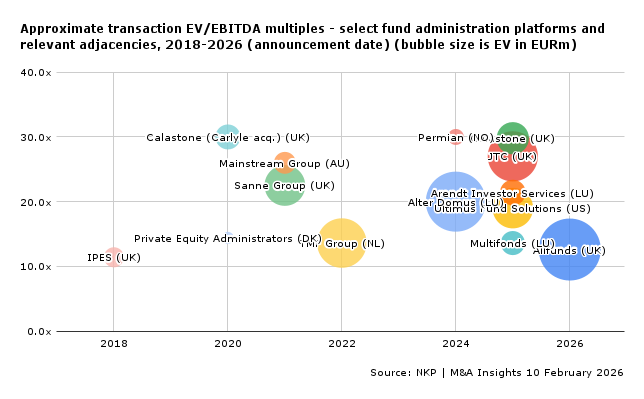
Taken together, the transactions outlined above suggest that established fund administration platforms have typically transacted at EV/EBITDA multiples ranging from the low-teens to the low-twenties, with notable outliers at both ends of the spectrum.
Higher multiples have generally been observed for platforms with strong exposure to private markets, complex fund structures, and jurisdictionally diverse regulatory obligations, where client switching costs are high and revenue visibility is strong. In contrast, businesses operating in more standardised or commoditised segments of fund servicing, or those with elevated operational risk, have tended to transact at more moderate valuation levels.
Importantly, the dispersion observed across transactions reflects structural differences rather than market timing alone. Even within broadly similar macro environments, outcomes have varied materially depending on business mix, operating model, and perceived scalability of earnings.
As a result, headline averages offer limited insight in isolation. Interpreting valuation outcomes in fund administration requires a granular understanding of where a platform sits within the fund services value chain and how defensible its earnings profile is.
Select transactions at materially higher multiples typically reflect assets with network effects, exceptional growth profiles, or unique positioning within the fund services ecosystem, and should not be interpreted as representative of the broader category.
Valuation dispersion in fund administration is driven less by the “fund admin” label itself and more by a combination of commercial, structural, and operational factors.
Key drivers typically include:
Technology enablement can also influence buyer perception, particularly where proprietary systems demonstrably improve efficiency, margin progression, or client retention. However, buyers have generally treated technology as an enabler of scalability, rather than a standalone valuation driver.
As a result, superficially similar fund administration platforms can trade at meaningfully different valuation levels.
The buyer universe for fund administration platforms is dominated by financial sponsors, with strategic acquirers playing a more selective role.
Private equity buyers are typically attracted by:
Strategic buyers, including exchanges, financial infrastructure providers, and large asset servicers, tend to focus on fund administration platforms as:
Cross-border acquisition activity is common, particularly where regulatory complexity and local authorisation requirements create barriers to entry and reinforce incumbent advantage.
Despite broader macroeconomic uncertainty and more selective M&A activity across financial services, buyer interest in fund administration platforms has remained comparatively resilient.
While growth expectations have moderated in some segments, demand for outsourced fund servicing has not diminished. Regulatory obligations, investor transparency requirements, and operational scrutiny continue to support long-term demand for specialist administrators.
As illustrated by recent transactions, buyers continue to prioritise platforms with defensible client relationships, strong private markets exposure, and scalable operating models. Valuation outcomes have therefore remained more range-bound than in many discretionary services categories, with company-specific fundamentals outweighing short-term sentiment.
One common misconception is that fund administration is a uniformly commoditised, low-growth services market. In practice, valuation outcomes vary widely depending on client mix, regulatory exposure, and operational complexity.
Another frequent assumption is that scale alone guarantees premium valuation. While scale can support efficiency and resilience, buyers place equal weight on earnings quality, client concentration, and the sustainability of margins.
Finally, fund administration platforms are often compared directly to software businesses. While some platforms benefit from technology-enabled operating models, buyers generally continue to underwrite these assets primarily on cash flow durability and defensibility, rather than software-style growth narratives.
NKP’s focus is editorial coverage for professional investors and advisors. We do not provide bespoke valuation opinions or comp analyses on request.
We work directly with company owners or sell-side advisors where there is a clear rationale for coverage that would be relevant to our subscriber base - typically to ensure accurate context and positioning.
If you believe your company or situation fits that category, you are welcome to reach out in confidence - we will treat it confidentially, and with no obligations implied.
Valuation references are indicative and reflect NKP’s assessment of historical transactions based on available information at the time. Supporting detail and methodology are available to subscribers.
 Download as PDF
Whether you are exploring a subscription or would like to discuss a situation relevant to our coverage, you are welcome to contact us directly.
%20(6).png)