.png)
A report by NKP | M&A Insights - Website Edition
Mapping valuation dynamics and emerging opportunities across European defence platforms
Updated: 10 July 2026
This subscriber edition maps valuation outcomes and consolidation dynamics across European defence platforms, with a particular focus on Northern Europe (the UK, DACH, Benelux, and the Nordics), and highlights where M&A activity is currently forming.
The once-in-a-generation European rearmament programme, driven by Russia's invasion of Ukraine and a shifting US posture towards NATO under President Trump, has created substantial opportunities for defence OEMs and sub-suppliers. Investors are increasingly alert to this, but the rapidly evolving landscape remains difficult to navigate for industry outsiders.
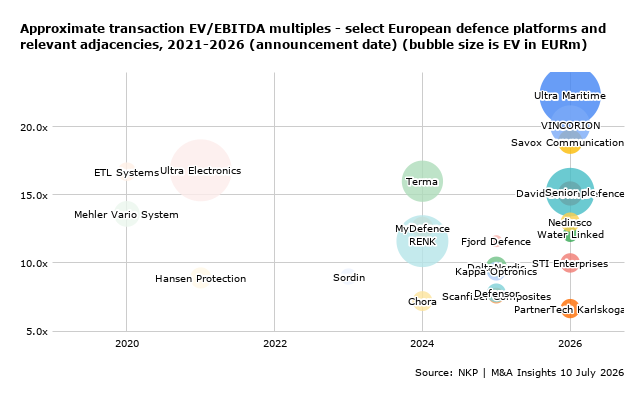
Drawing on observed transactions from 2020–2026 and NKP | M&A Insights' proprietary tracking of emerging situations, the report shows why European defence should not be treated as a single valuation category. Observed EV/EBITDA outcomes range from approximately 6x to the low twenties, with most transactions clustering around 9x–13x and public-market references extending the range to approximately 20x. The widest premiums attach to businesses with proprietary IP, programme embeddedness, and certification barriers, and to those exposed to structurally funded priorities such as electronic warfare, counter-UAS, C4ISR, munitions supply chains, and naval defence.
The analysis is intended to support investors and advisers in understanding current valuation benchmarks, ownership dynamics, buyer appetite, and the forward pipeline of opportunities as observed at mid-2026.
NKP | M&A Insights provides proprietary, validated, early-stage M&A intelligence across Northern Europe - surfacing and contextualising non-public ownership and transaction dynamics, often months before formal processes emerge and broader market visibility.
Subscribers receive a daily curated intelligence feed, continuous tracking of emerging and live situations, and embedded cross-border context on combination opportunities, valuation levels, and buyer mappings. On average, we surface 5–7 new situations daily, most of which are not covered by traditional M&A platforms, and typically months before broader market visibility.
Trusted by 220+ private equity and advisory teams, NKP acts as an intelligence infrastructure layer to reduce information asymmetry and strengthen origination and competitive positioning in a traditionally opaque market.
The situations referenced in this report draw on this intelligence base and are intended to provide additional forward-looking context alongside the valuation analysis presented herein.
For the purpose of this analysis, European defence platforms are businesses that design, manufacture, or service products, components, subsystems, and technology with direct, material exposure to European defence procurement and rearmament programmes.
The defining characteristic is meaningful defence revenue from European customers: defence ministries, armed forces, or prime contractors under active procurement and rearmament programmes. Businesses range from prime contractors down through the lower tiers of the supply chain, and this analysis covers primes, Tier 1, and Tier 2 suppliers.
This includes providers offering:
This analysis does not include:
European defence platforms have attracted sustained buyer interest due to a combination of politically mandated spending increases, mission-critical supply chain exposure, fragmented market structures, and demand characteristics that are structurally insulated from economic cycles.
Across primes, Tier 1 and Tier 2 suppliers, and specialist service providers, defence production, maintenance, and capability delivery remain non-discretionary for European governments. The technical complexity, certification requirements, and national security importance of these activities support long-term relationships between governments and their approved industrial partners.
From a buyer and investor perspective, this typically translates into:
Many businesses are also expanding beyond their original manufacturing or service mandates into adjacent dual-use technologies, electronics, autonomous systems, and digital service models. This creates scope for cross-sell, capability expansion, and post-acquisition scaling.
As a result, well-positioned European defence platforms - particularly those with direct exposure to new government contracts and rearmament programmes - often exhibit revenue durability, visibility, and growth that continue to attract both financial sponsors and strategic consolidators. Cash conversion, however, varies significantly across the sector.
While often grouped under a single "defence" label, the sector spans multiple sub-segments with materially different operating models and valuation characteristics. At a high level, the defence industry is structured as a hierarchical pyramid, categorised by contracting relationships, technical complexity, and margin profiles.
Understanding where a business sits across this spectrum is critical to interpreting valuation outcomes. Segment positioning drives revenue visibility, margin quality, IP ownership, and buy-and-build potential — and dispersion across these dimensions is structural, not cyclical.
Primes hold the direct primary relationship with sovereign governments under long-dated contracts. This segment has expanded beyond traditional hardware OEMs to include bulk munition manufacturers, global service giants, and modern technology platforms.
Tier 1 firms are direct partners to the primes, manufacturing large, mission-critical subsystems that define the performance and intelligence of the final platform.
Tier 2 suppliers feed tier 1 integrators and occasionally supply primes directly. They are highly specialized engineering, manufacturing, and technology firms.
Tier 3 operates at the furthest upstream layer of the defence ecosystem, providing the foundational elements required by the lower tiers.
* Tier 3 is shown for context only and is not included in this report.
Transaction details, full valuation metrics, and supporting context are available to NKP subscribers.
Given the mix of large-scale, listed and private-equity-backed consolidation platforms and smaller, founder-built specialist manufacturers, valuation references are presented on an EV/EBITDA basis, reflecting its standing as the primary multiple for comparing profitability across the diverse business models represented in the defence sector.
Multiples are a mix of trailing and forward metrics, with the earnings period for each observed transaction stated in its description.
Presented here in chronological order.
~21.6–23x
EV/EBITDA (2026E)
Ultra Maritime is a UK-based provider of undersea and anti-submarine warfare solutions. The business is relevant in a defence valuation context as a scaled undersea-warfare specialist carved out of a private-equity-backed platform and acquired by a global strategic prime, and as a rare large-cap data point at the premium end of the observed range.
According to Lockheed Martin's announcement, it agreed to acquire Ultra Maritime from Advent International-backed Cobham Ultra at an enterprise value of USD 3.45bn. According to NKP | M&A Insights' sources, Ultra Maritime is expected to generate revenue of approximately USD 784m and EBITDA of approximately USD 150–160m for FY2026E). This implies an EV/Sales (FY1) of 4.4x and an EV/EBITDA (FY1) of 21.6–23x. The transaction remains subject to regulatory approval.
~12.5–15.7x
EV/EBITDA (2025R)
David Brown Defence (DBD) is a UK-based manufacturer of gearboxes and power-transmission systems for naval and land defence platforms, supplying the UK's Type 26 frigate and the Challenger 2 and Boxer vehicle platforms. It is a single-country naval and land transmission specialist, recently carved out of a broader industrial gearing group and acquired by a listed strategic consolidator seeking Five Eyes naval access.
According to Bloomberg's sources, the deal values DBD at enterprise value of USD 200m–250m (EUR 175m -220m). Per RENK's acquisition presentation, the business generated FY2025 revenue of ~EUR 90m. Applying DBD's FY2024 EBITDA margin prior to recharges of 15.6% to FY2025 revenue implies FY2025 EBITDA of EUR 14m. This implies an EV/Sales (FY0) of 1.9x–2.4x and an EV/EBITDA (FY0) of 12.5x–15.7x.
18.9x
EV/adj. EBITDA (2025R)
Savox Communications is a Finland-based provider of critical communications solutions for the defence, public safety, and industrial sectors, with a product portfolio spanning tactical communication controllers, advanced hearing protection, rugged ICT devices, and search-and-rescue systems. The business is relevant in a defence valuation context as a listing-based valuation reference for a scaled, defence-weighted communications-equipment specialist.
According to official reports, Savox completed an oversubscribed IPO on Nasdaq Helsinki, raising c. EUR 30m in primary proceeds at an offer price of EUR 10.72 per share, implying a post-money market capitalisation of c. EUR 190m. Per NKP's analysis of the prospectus dated 8 June 2026, this bridges to an enterprise value of c. EUR 201m, adding reported net debt of EUR 36.6m as at 31 December 2025 and deducting c. EUR 26m of net primary proceeds. For FY2025, Savox reported revenue of EUR 56.1m and adjusted EBITDA of EUR 10.6m, reflecting an EV/Sales (FY0) of 3.6x and an EV/adj. EBITDA (FY0) of 18.9x.
11–13.2x
EV/EBITDA (2026E)
Water Linked is a Norway-based provider of underwater navigation and 3D sonar technology, supplying Doppler velocity logs, imaging sonars, underwater modems, and acoustic positioning systems to the global maritime, defence, and offshore energy markets. The business is relevant in a defence valuation context as a high-growth, high-margin subsea-navigation specialist acquired by a listed strategic to extend its underwater-vehicle technology offering, and as an exit for early venture backers.
According to Norbit's announcement, the listed group agreed to acquire 100% of Water Linked from Equinor Ventures and Investinor at an enterprise value of NOK 330m on a cash- and debt-free basis, fully cash-settled and financed through a new term loan. Water Linked is expected to generate revenue of c. NOK 100m in 2026 at an EBITDA margin of 25–30%. This implies an EV/Sales (FY1) of 3.3x and, on implied FY2026E EBITDA of c. NOK 25–30m, an EV/EBITDA (FY1) of c. 11–13.2x.
6.4–6.9x
EV/EBITDA (2026E)
PartnerTech Karlskoga is a Sweden-based manufacturer of high-precision strategic metal components for global defence OEMs, specialising in components for weapon systems and large-calibre ammunition, with approximately 92% of revenue derived from defence OEMs and manufacturing. The business is relevant in a defence valuation context as a deeply embedded, sole-source component supplier to major European defence OEMs, acquired as a scale-adding "build" step for a listed buy-and-build platform.
According to Fjord Defence Group's announcement, it agreed to acquire 100% of PartnerTech Karlskoga from Permec Group at a cash- and debt-free enterprise value of SEK 900m, corresponding to an equity value of approximately SEK 708m. According to NKP | M&A Insights' sources, PartnerTech is expected to generate FY2026 revenue exceeding SEK 700m and EBITDA of approximately SEK 130–140m, implying an EV/Sales (FY1) of +1.3x and an EV/EBITDA (FY1) of ~6.4–6.9x.
15.2x
EV/adj. EBITDA (2025-12R)
Senior plc is a UK-based, London-listed designer and manufacturer of fluid conveyance, fuel-control, and structural components for the aerospace, defence, and energy markets. The business is relevant in a defence valuation context as a scaled, listed aerospace and defence supplier taken private.
According to the offer announcement, Blackstone and Tinicum agreed to acquire Senior plc at an enterprise value of GBP 1,399m, with the cash consideration valuing the fully diluted equity at approximately GBP 1,275m. For the year ended 31 December 2025, Senior reported revenue of GBP 738.2m and adjusted EBITDA of GBP 92.3m, reflecting an EV/Sales (FY0) of 1.9x and an EV/adj. EBITDA (FY0) of 15.2x.
~20.1x
EV/adj. EBITDA (2025-12R)
VINCORION is a German-based developer and manufacturer of mission-critical power and mechatronic solutions for defence and aviation systems. The business is relevant in a defence valuation context as an IPO-based valuation reference for a scaled, aftermarket-weighted defence supplier amid strong investor appetite for the sector.
According to public reporting at the time, VINCORION completed an all-secondary IPO on the Frankfurt Stock Exchange, through which its existing shareholder, STAR Capital, sold down approximately EUR 345m of stock at a market capitalisation of approximately EUR 850m, implying an enterprise value of approximately EUR 967m, per STAR Capital's announcement. For the financial year 2025, VINCORION reported revenue of EUR 240m and adj. EBITDA of EUR 48.2m, reflecting an EV/Sales (FY0) of ~4.0x and an EV/adj. EBITDA (FY0) of ~20.1x.
~10x
EV/adj. EBITDA (2026-12E)
STI Enterprises is a UK-based electronics manufacturing services provider specialising in electronic solutions for the defence industry, operating across the air, land, cyber, and marine domains. The business is relevant in a defence valuation context as a specialist defence-electronics manufacturer acquired by a listed strategic consolidator expanding its UK defence footprint.
According to NOTE's announcement, NOTE AB acquired 100% of STI from Rcapital for GBP 72.5m on a cash- and debt-free basis. NOTE states this reflects an adjusted EV/EBITDA of ~10x. STI is expected to generate revenue of approximately GBP 60m in 2026. These are the official figures from the announcement. This implies an EV/Sales (FY1) of ~1.2x. The 10x multiple implies adjusted EBITDA of approximately GBP 7m in 2026E.
~11–15x
EV/EBITDA (2026-12E)
Nedinsco is a Netherlands-based defence optronics specialist, founded in 1921 and headquartered in Venlo, designing and manufacturing periscopes, driver-vision systems, and sensor units for major European land platforms including Boxer, Lynx, CV90, Puma, and Leopard 2A8, and supplying OEMs such as Rheinmetall, KNDS, and BAE Systems. The business is relevant in a defence valuation context as a specialist optronics supplier with deep platform embedment, acquired by a listed strategic to expand its optronics capability.
According to Hensoldt's investor materials, Hensoldt agreed in March 2026 to acquire 100% of Nedinsco for a "high double-digit EUR million" enterprise value at an FY2026E EV/EBITDA multiple in the "low- to mid-teens". The wording implies an enterprise value of approximately EUR 80–99m and an EV/EBITDA (FY1) of approximately 11–15x, corresponding to an implied FY2026E EBITDA of approximately EUR 5–7m.
9.7x
EV/EBITDA (2026-12E)
DeltaNordic is a Sweden-based supplier of advanced electronics and electrical systems serving the defence and other high-demand sectors, with production facilities in Sweden and China. The business is relevant in a defence valuation context as an electronics manufacturer with substantial defence exposure acquired by a listed strategic, strengthening its defence positioning, with approximately half of its revenue derived from defence clients.
According to Kitron's announcement, Kitron agreed to acquire DeltaNordic at an enterprise value of SEK 1,255m, including earn-out, on a debt- and cash-free basis, settled through cash of SEK 760m, Kitron shares of SEK 150m and an earn-out of SEK 345m, subject to revenue fulfilment. DeltaNordic is projected to generate revenue of approximately SEK 815m and EBITDA of approximately SEK 130m in 2026E, implying an EV/Sales (FY1) of approximately 1.5x and an EV/EBITDA (FY1) of approximately 9.7x.
7.6x
EV/EBITDA (2024/25-09R)
Scanfiber Composites is a Denmark-based manufacturer of advanced composite ballistic protection solutions for vehicles, vessels, aircraft, buildings, and personnel, serving blue-chip military OEM customers across Europe with nearly 30 years of industry experience. The business is relevant in a defence valuation context as a profitable, fast-growing ballistic-protection specialist acquired by a listed defence consolidator for platform expansion.
According to Fjord Defence Group's announcement, it agreed to acquire 100% of Scanfiber at an enterprise value of DKK 255m (NOK 397.8m) on a cash- and debt-free basis. For the financial year ended September 2025, Scanfiber reported revenue of DKK 102m and EBITDA of DKK 33.6m, reflecting an EV/Sales (FY0) of 2.5x and an EV/EBITDA (FY0) of 7.6x.
~7.8x
EV/EBITDA (2025E)
Defensor Group is a newly formed Swedish defence and security platform. It was assembled by Flat Capital, the investment company of Klarna founder Sebastian Siemiatkowski, to consolidate founder-built Nordic defence assets amid the European rearmament cycle. At formation it brought together two businesses; (i) ArmaTech, a Nordic defence systems supplier and integrator, and (ii) SAFE4U, a Swedish manufacturer of ballistic protection for government and military customers. The business is relevant in a defence valuation context as a newly assembled buy-and-build platform with stated IPO ambitions.
According to the announcement, the transaction valued Defensor at an aggregate equity value of SEK 733m. Including net debt of SEK 100m, the enterprise value was approximately SEK 833m. On a 100% basis, ArmaTech and SAFE4U are together expected to generate combined 2025 revenue and EBIT of approximately SEK 410m and SEK 100m, respectively. This implies an EV/Sales (FY1) of ~2.0x and an EV/EBIT (FY1) of ~8.3x. EBITDA was not disclosed in the announcement. Their latest annual accounts (ArmaTech FY2025-12 and SAFE4U FY2025-08) imply a blended EBITDA margin of ~26%. Applied to the stated combined 2025 revenue, this implies EBITDA of ~SEK 107m and thus an implied EV/EBITDA (FY1) of ~7.8x.
~9.4x
EV/EBITDA (2025E)
Kappa Optronics is a Germany-based developer of mission-critical optronics systems for aviation and land defence platforms, headquartered in Göttingen. The business is relevant in a defence valuation context as a specialist optronics manufacturer acquired by a listed strategic, strengthening its electro-optic product portfolio and R&D capabilities.
According to Theon's announcement, Theon International - a Cyprus headquartered firm - acquired 100% of Kappa Optronics from private equity firm Afinum at an enterprise value of EUR 75m. Kappa was expected to generate revenue of approximately EUR 37m and EBITDA of approximately EUR 8m in 2025E, the deal thus implying an EV/Sales (FY1) of ~2.0x and an EV/EBITDA (FY1) of ~9.4x.
11.6x
EV/EBITDA (2024-12R)
Fjord Defence is a Norway-based niche supplier of weapon integration solutions, including tripods, weapon mounts, and accessories for ground, vehicle, and maritime applications. It operates a capital-light development-and-assembly model and sells to customers across 18 user nations. The business is relevant in a defence valuation context as a profitable, founder-built niche supplier acquired by a listed strategic. It was also the founding acquisition behind Fjord Defence Group, the buy-and-build platform that later acquired Scanfiber (see above).
According to Aquila's announcement, Aquila Holdings acquired 99% of Fjord Defence at an enterprise value of NOK 178m (cash- and debt-free basis). This comprised an equity purchase price of NOK 170.2m plus net debt of approximately NOK 8m. The consideration was settled primarily in new Aquila shares and partly in cash. For the financial year 2024, Fjord Defence reported revenue of NOK 87m and EBITDA of NOK 15.4m. This implied an EV/Sales (FY0) of 2.0x and an EV/EBITDA (FY0) of 11.6x.
~7.2x
EV/EBITDA (2024E)
Chora is a Denmark-based developer and manufacturer of mission-critical communication and antenna systems for the electronic warfare sector. The business is relevant in a defence valuation context as a scarce private-equity valuation reference for a pure electronic-warfare specialist, distinguished by a particularly high EBITDA margin.
According to NKP’s analysis of the statutory accounts of the acquisition entity, Fabelgade ApS, the Danish private equity firm Solix’s acquisition of a majority stake in Chora valued the company at an EV of DKK 687m. According to NKP | M&A Insights’ sources, Chora had been marketed off projected 2024 revenue of approximately DKK 160m with an EBITDA margin of approximately 60%, implying 2024E EBITDA at the time of acquisition of approximately DKK 96m. Based on these figures, the deal reflected an EV/EBITDA (FY1) of approximately 7.2x. The modest multiple should be considered in the light of Chora’s relatively poor cash conversion.
16x
EV/EBITDA (2023/24-02R)
Terma is a Danish diversified high-technology defence supplier, spanning command-and-control and radar systems, aircraft self-protection, space technology, and aerostructures, with significant exposure to the F-35 programme. The business is relevant in a defence valuation context as a data point on a scaled, diversified prime defence platform, and as an institutional minority investment backing an acquisition-led growth strategy.
In June 2024, ATP acquired a 10% minority stake in Terma. According to NKP’s analysis of the pre-and post acquisition statutory accounts for Thrige Holding A/S, the majority owner of Terma and prior to ATP’s investment also its sole owner, ATP’s investment resulted in capital increase “from minority interest in subsidiaries” of DKK 784.8m. Given that ATP acquired a 10% stake, this valued the entire equity at DKK 7,840m, and an enterprise value of the same amount (Thrige Holding had no meaningful net debt according to its 2024/25 filings). For the financial year ended February 2024, Terma reported revenue of DKK 2.6bn and EBITDA before special items of DKK 488m, which thus implies that ATP’s investment reflect an EV/EBITDA (2023/24-02R ~ FY0) of 16x.
~12.6x
EV/EBITDA (2024E)
MyDefence is a Denmark-based counter-unmanned aerial systems (C-UAS) company, specialising in RF-based drone detection, tracking, and mitigation solutions for military, security, and critical-infrastructure customers, with deployments across Europe, North America, and Ukraine. The business is relevant in a defence valuation context as a battle-proven, high-margin, high-growth specialist in the rapidly expanding counter-drone niche, acquired by an institutional private equity firm.
According to NKP | M&A Insights' post-acquisition analysis of Revelio HoldCo ApS, Bridgepoint acquired a 90% stake in MyDefence at an implied enterprise value of approximately DKK 950m, with management reinvesting for the remaining approximately 10%. On expected 2024 financials of approximately DKK 150m revenue and DKK 75m EBITDA, this implies an EV/Sales (FY1) of approximately 6.3x and an EV/EBITDA (FY1) of approximately 12.6x.
~11.6x
EV/EBITDA (2023-12R)
RENK is a Germany-based specialist manufacturer of gearboxes and transmission systems for military tracked vehicles, as well as drive technology for naval and industrial applications. The business is relevant in a defence valuation context as a listing-based valuation reference for a scaled, mission-critical defence powertrain supplier, following a sponsor exit via the public markets.
In February 2024, private equity firm Triton listed RENK on the Frankfurt Stock Exchange through a private placement of shares to institutional investors, raising net proceeds of approximately EUR 369m and valuing the company at a market capitalisation of ~EUR 1.5bn (EUR 15 per share). Adding net debt of approximately EUR 444m (per RENK's 2023 annual report) implies an IPO enterprise value of ~EUR 1.94bn. For the financial year 2023, RENK had reported revenue of EUR 925.5m and EBITDA of EUR 167.5m, reflecting an EV/Sales (FY0) of ~2.1x and an EV/EBITDA (FY0) of ~11.6x.
~9x
EV/EBITDA (2023E)
Sordin is a Sweden-based provider of premium hearing protection equipment, with a particular focus on military, law enforcement, and hunting applications. The business is relevant in a defence valuation context as a specialist personal-equipment supplier to military and security end-users, acquired by an investment company pursuing organic and acquisitive growth.
According to NKP | M&A Insights' post-acquisition analysis of Dcbl BidCo AB's (the acquisition vehicle's) statutory accounts, the investment firm Coeli acquired a majority stake in Sordin in November 2023 at an implied enterprise value of SEK 444m, with prior owner DeVenture remaining a significant minority shareholder. On expected 2023 EBITDA of approximately SEK 49m at the time of acquisition (as per NKP’s sources), this implied an EV/EBITDA (FY1) of around 9x.
16.8x
EV/adj. EBITDA (2021-06R)
Ultra Electronics is a UK-based defence and security company providing electronic and electrical systems, software, and solutions across the maritime, aerospace, nuclear, and industrial-sensors markets, operating primarily as a Tier 2 subsystem supplier and occasionally at Tier 1. The business is relevant in a defence valuation context as a scaled, listed, diversified defence-electronics asset taken private.
According to the transaction terms, Cobham - backed by private equity firm Advent International - acquired Ultra Electronics at a cash acquisition price of GBP 2.57bn for the equity. Adding net debt of approximately GBP 40m (per Ultra's 2021 annual report) implies an enterprise value of ~GBP 2.61bn. Based on H1-2021 annualised figures, Ultra had revenue of GBP 820m and adjusted EBITDA of GBP 155m at the time of acquisition, reflecting a pro-forma EV/Sales (FY0) of 3.2x and an EV/adj. EBITDA (FY0) of 16.8x.
~8.9x
EV/adj. EBITDA (2020-12R)
Hansen Protection is a Norway-based manufacturer of survival and personal-protection equipment — including immersion suits, survival suits, and protective clothing — serving defence, maritime, energy, agriculture, and emergency-response customers. The business is relevant in a defence valuation context as a high-margin survival-equipment specialist for which defence is one of several end-markets, acquired by Survitec Group, a global survival-technology provider across maritime, defence and government, energy, and aerospace.
According to NKP | M&A Insights' sources, IK Partners sold Hansen Protection to Survitec Group at an enterprise value of approximately NOK 1,330m. For the financial year 2020, Hansen had reported revenue of NOK 324.5m and adjusted EBITDA of NOK 150m, the investment thus reflecting an EV/Sales (FY0) of approximately 4.1x and an EV/EBITDA (FY0) of approximately 8.9x.
~13.6x
EV/EBITDA (2020-12R)
Mehler Vario System is a German-based manufacturer of ballistic protective vests, tactical equipment and clothing, and vehicle protection systems, positioned as a leading European supplier in its field. The business is relevant in a defence valuation context as a scaled, market-leading personal-protection and ballistic-equipment manufacturer acquired by private equity to pursue acquisition-led growth.
According to NKP | M&A Insights' detailed analysis of the statutory accounts of M-Personal Protection Holding GmbH (the acquisition vehicle), Deutsche Private Equity acquired a majority stake in Mehler Vario System from the investment holding company Armira at an implied enterprise value of approximately EUR 228m, excluding earn-outs, and EUR 248.5m, including earn-outs. For the financial year 2020, Mehler Vario System had reported revenue of EUR 107.4m and EBITDA of EUR 18.3m, the deal thus reflecting an EV/Sales (FY0) of ~2.3x and an EV/EBITDA (FY0) of ~13.6x on an inclusive-of-earn-outs basis.
~16.7x
EV/EBITDA (2019/20-05R)
ETL Systems is a UK-based designer and manufacturer of radio-frequency (RF) distribution equipment for the global satellite communications ecosystem, supplying mission-critical infrastructure to government and defence networks, satellite operators, broadcasters, and maritime connectivity providers. The business is relevant in a defence valuation context as a specialist supplier of RF ground-segment equipment with deep defence and NATO exposure, acquired by private equity ahead of a buy-and-build expansion.
According to NKP | M&A Insights' detailed analysis of the statutory accounts of ETL Midco Limited (the acquisition vehicle), CBPE Capital invested in ETL Systems at an implied enterprise value of GBP 58.5m. For the financial year ended May 2020, ETL reported turnover of GBP 19.8m and unadjusted EBITDA of GBP 3.5m, reflecting an EV/Sales (FY1) of approximately 3.0x and an EV/EBITDA (FY1) of approximately 16.7x with the reasonable assumption that CBPE had decent visibility into these numbers as of January.
Across the 23 transactions analysed, EV/EBITDA outcomes span from 6.7x to the low 20s, with most deals clustering between 9x and 13x. The spread is wide, and it is structural, not cyclical. The bands below group the transactions by outcome.
Broadly:
The key takeaway is that European defence is not a single valuation category.
Neither scale nor defence revenue commands a premium on its own. What moves a business up the range is whether a competitor could rebuild its position. A sole-source seat on an active programme, proprietary technology, or a certification that took years to earn cannot easily be displaced. The drivers behind that dispersion are set out below.
Across the transactions analysed, valuation appears to track the quality of the earnings behind a business more closely than the "defence" label itself. Buyers are, in effect, underwriting how durable and how scalable those earnings are, rather than the presence of government contracts alone. Six drivers recur across the deal set. They are not the only factors at work, but they are the ones most consistently visible in how transactions have been priced.
1. Revenue visibility. Sole-source or qualified positions on active programmes tend to carry an earnings defensibility that open-market competitors cannot easily match. Re-qualification cycles, certification, and security clearances raise switching costs, and buyers appear to price that directly. Visibility is often highest in aftermarket and lifecycle work: once a platform is in service, it must be maintained for its full life, which can turn MRO into long-dated, annuity-like revenue that is largely decoupled from new-order cycles. This can lift a business at any tier, from prime to component supplier.
2. Margin quality. High headline margins tend to be necessary but not sufficient. What buyers appear to pay for is a margin that converts to cash. Where earnings rest on proprietary content or recurring aftermarket work, margin quality is typically high and durable. Where the cash conversion cycle is long, the achievable multiple often looks capped regardless of reported profitability.
3. IP & technological moat. Owning the technology tends to command a structural premium over contract manufacturing or assembly. This is clearest in defence electronics - optronics, electronic warfare, RF systems, C4ISR, and counter-drone systems - where proprietary IP and software content support both higher margins and stronger exit optionality. These technology-led businesses increasingly trade closer to software than to industrials, and tend to sit towards the top of the range. A build-to-print position, by contrast, carries little moat at any tier and tends to price as an industrial.
4. Capital intensity. Asset-light models tend to price above capital-hungry manufacturers. Where earnings depend on throughput, fixed-price delivery, or heavy plant rather than on IP and customer lock-in, reinvestment and working capital can erode free cash flow, and the achievable multiple is often structurally lower.
5. Alignment with funded rearmament priorities. Rearmament spending is concentrated rather than uniform. Exposure to active capability gaps - munitions supply chains, counter-UAS, C4ISR, and naval defence - appears to earn a growth premium over more mature or lower-priority programmes, largely independent of tier or asset quality.
6. Buy-and-build credibility. The lower-tier supply base remains highly fragmented. Buyers appear willing to pay a measurable premium where a platform has the management depth, accreditation infrastructure, and integration record to consolidate that base, rather than simply run a good business on its own.
The broad pattern is that these drivers compound rather than operate in isolation.
The highest multiples attach to businesses that combine several at once: proprietary IP, a sole-source programme position, aftermarket-led revenue visibility, and an asset-light model. No single driver lifts a business to the top of the range on its own, and a weakness in one can cap the multiple even where the others are strong – Chora's proprietary electronic-warfare position priced at only c. 7.2x on weak cash conversion. The drivers also cut across tier: each can lift or cap a business whether it sits at prime, Tier 1, or Tier 2, which is why tier alone does not sort the observed range.
Several of these drivers tend to move in a fairly predictable way across the supply chain. The table below maps each tier against them. Alignment with rearmament priorities is not shown, as it is general for all tiers.
[TABLE IS AVAILABLE IN SUBSCRIBER EDITION ONLY]
The buyer universe in European defence spans private equity sponsors, listed defence primes and Tier 1 strategics, dedicated buy-and-build consolidators, and a small number of institutional and sovereign-linked investors. Buyers are drawn from across the value chain - primes acquiring upstream component and subsystem suppliers, electronics and optronics specialists adding complementary IP, and newly formed platforms assembling fragmented, founder-owned national markets.
Buyer appetite is underpinned by the non-discretionary, structurally funded nature of European rearmament spending. Many of the targets observed sit close to active, funded programmes - supplying components, subsystems, electronics, or aftermarket support that prime contractors and defence ministries cannot easily resource elsewhere once a supplier has been qualified, certified, or designed in.
Sponsor exits via public listing, strategic bolt-ons, and the first institutionalisation of founder-owned businesses all feature in the observed transaction set, suggesting buyer appetite spans the full ownership-transition spectrum rather than concentrating in a single deal type. Competition is typically strongest for assets that combine proprietary technology or qualified-programme positions with a credible path to scale, rather than for defence exposure or government-contract visibility alone.
M&A activity in European defence has accelerated at the intersection of two reinforcing forces. National defence budgets and NATO spending commitments are rising sharply. At the same time, the war in Ukraine and the wider deterioration in European security have widened capability gaps and compressed procurement timelines. Together these are translating into expanding, multi-year procurement programmes across air, land, naval, and space domains.
Unlike sectors where demand is tied to discretionary corporate spending, European defence demand is politically mandated and only loosely correlated with the broader economic cycle. This insulation is part of what attracts buyers, but it also creates capacity constraints: prime contractors and defence ministries are increasingly pushing toward already-qualified, scaled suppliers across the lower tiers of the supply chain - particularly in munitions, electronics, and precision components - where security clearance, certification, and qualification requirements concentrate activity around accredited platforms rather than the broader market.
Platforms that already hold the right accreditations, clearances, and customer relationships are better positioned to absorb expanding order volumes and serve multiple primes or programmes simultaneously. Much of the lower-tier supply base across the Nordics, DACH, and the UK remains founder-owned and sub-scale, creating clear opportunities for bolt-on acquisitions or platform formation.
Recent transactions across components, electronics, optronics, ballistic protection, and unmanned systems suggest that buyer appetite spans the full breadth of the defence supply chain rather than concentrating in a single niche. Investors and strategics alike are targeting businesses that can convert funded programme demand into durable, repeatable earnings through qualification barriers, IP ownership, and operational scale.
Subscriber edition
The Northern European defence landscape includes a mix of sponsor-backed platforms, listed primes and Tier 1 strategics, founder-owned specialist manufacturers, and a small number of newly formed buy-and-build platforms. Private equity ownership has become increasingly visible across defence electronics, optronics, and specialist component manufacturing, particularly where businesses combine proprietary technology, qualification barriers, and a credible consolidation runway.
Prime contractors remain dominated by listed or large strategic ownership. This reflects both the scale and capital intensity the role requires and the sovereign sensitivity of core weapons programmes, which limits private ownership. Defence electronics and specialist component platforms, by contrast, have attracted the strongest sponsor and strategic interest, given their proprietary IP and qualification barriers. At the same time, many manufacturers in ballistic protection, tactical equipment, and precision components remain founder-owned, often with strong customer relationships but more limited scale or institutional ownership history.
Understanding this landscape is relevant for assessing both current consolidation dynamics and the pipeline of potential future transactions. The chart and table below provide an overview of selected European defence platforms, segmented by ownership type, defence segment, revenue, and approximate EBITDA
by revenue, service segment, and ownership type (bubble size = EBITDA)
Revenue and EBITDA figures are approximate and partly derived from non-public sources, including NKP proprietary estimates. Figures predominantly relate to financial years 2024, 2025, and 2026 estimates.
[CHART IS AVAILABLE IN SUBSCRIBER EDITION ONLY]
Source: NKP | M&A Insights, 10 July 2026
Defence segments as shown in the bubble chart:
6. Prime - Electronics
5. Prime - Industrial
4. Tier I - Electronics
3. Tier I - Industrial
2. Tier II - Electronics
1. Tier II - Industrial
Electronics vs. Industrial splits each tier by core product: Electronics covers sensors, communications, software and autonomy; Industrial covers physical materiel such as platforms, vehicles, weapons and protective equipment.
[FULL OWNERSHIP IS AVAILABLE IN SUBSCRIBER EDITION ONLY]
Source: NKP | M&A Insights, 10 July 2026
Financial figures represent the most recent reporting year available, 2024 or 2025 in most cases.
Subscriber edition
The following section highlights a selection of emerging M&A situations currently monitored by NKP | M&A Insights across the Northern European defence landscape.
The situations span defence electronics and sensors, components and precision engineering, protective equipment, unmanned systems and counter-UAS, communications platforms, and broader defence services. Some remain pre-process or early-stage, while others are understood to be more advanced, with advisor involvement, buyer outreach, or formal process preparation already underway.
Company identities and transaction details have been intentionally blinded. The purpose of this section is not to disclose specific processes, but to provide forward-looking situational awareness around where consolidation activity is forming and how the opportunity landscape is evolving.
To retrieve additional context, including the names of the referenced companies - search for “defence”, “drone”, or “weapon” (including the quotation marks) in the search field in Companies for Sale or contact us at research@mainsights.io for assistance.
Based on emerging situations currently being monitored across the European defence landscape, several themes appear to be shaping the next phase of consolidation. The observations below draw directly on the situations tracked by NKP | M&A Insights and the transaction evidence presented earlier in this report.
Fjord Defence Group and Defensor were each assembled by acquiring several small, founder-owned Nordic defence businesses into a single platform positioned for a listing or a strategic sale. The supply of targets is substantial: 20 of the 40 tracked situations remain founder- or family-owned. This model is likely to be repeated.
A disproportionate share of tracked situations falls within this segment, spanning drone detection, fixed-wing drones, unmanned ground vehicles, and interception systems. Most remain founder-owned and early in their ownership transition, and the war in Ukraine has shortened the usual qualification cycle from years to months. Proven demand, limited institutional ownership, and fragmentation make this the segment most likely to see intensifying activity, and it is where the widest valuations in the pipeline appear to be forming.
VINCORION listed at approximately 20x EV/EBITDA and RENK at approximately 11.6x, suggesting that public markets can price European defence at meaningful multiples. Several tracked situations are now listing-linked. But the listing appears increasingly used as a pricing tool rather than a straightforward exit, through dual-track sale-or-list processes and minority stakes placed ahead of an IPO. These situations are priced relative to listed peers such as RENK, Savox, and VINCORION, which may push expected multiples toward the top of the range.
Across the transaction set, the highest multiples tend to attach to businesses with proprietary IP, sole-source positions, or deep programme certification, rather than to the largest or most diversified suppliers. Ultra Electronics at 16.8x and ETL Systems at 16.7x were both priced to secure an embedded position that would have taken years to replicate. A useful question for a buyer is whether the business can be displaced once it has been designed into a programme. For the strongest assets in this set, it cannot.
Earlier cycles concentrated on primes and large electronics groups. The current pipeline sits lower in the chain, across precision components, specialist manufacturers, protective equipment, and field services, much of which has never had an institutional owner. Primes and defence ministries appear increasingly aware that meeting their order books depends on these lower tiers scaling. This lower-tier cluster appears to be the more substitutable side of the market. It will likely trade in the 6x–12x industrial band unless a business carries genuine IP, in contrast to the premiums seen at higher multiples.
Structural demand is broad, but not all defence exposure is valued equally. Scarce capability, a sole-source position, or strategic geographic density is likely to draw competition from both sponsors and strategics, whereas plain defence revenue is more likely to be treated as a bolt-on. Commoditised or project-led operators will still transact, but buyers are increasingly disciplined about what they will pay a premium for.
The situations below represent a selection of emerging opportunities currently monitored within the Northern European defence landscape. These situations vary in maturity, ranging from early-stage strategic discussions to situations where more formal processes may emerge over time - company names and identifying details have been intentionally omitted.
The table below lists all tracked situations by EBITDA. Detailed profiles follow, grouped by region and sorted by EBITDA (Nordics, DACH, UK&I, Benelux, and France)
[TABLE AVAILABLE IN SUBSCRIBER EDITION ONLY]
Source: NKP | M&A Insights, 10 July 2026
EBITDA reflects the earnings period stated for each situation and may be reported, estimated, or annualised. Where only EBIT or revenue was available, that figure is shown. Ordering is on an EUR-equivalent basis
[EMERGING SITUATIONS AVAILABLE IN SUBSCRIBER EDITION ONLY]
[EMERGING SITUATIONS AVAILABLE IN SUBSCRIBER EDITION ONLY]
[EMERGING SITUATIONS AVAILABLE IN SUBSCRIBER EDITION ONLY]
[EMERGING SITUATIONS AVAILABLE IN SUBSCRIBER EDITION ONLY]
[EMERGING SITUATIONS AVAILABLE IN SUBSCRIBER EDITION ONLY]
Drawing on the transaction evidence and tracked situations set out in this report, several broad patterns can be inferred. They are best read as directional rather than definitive. The backdrop is a funded, multi-year rearmament cycle largely decoupled from the broader economic cycle, which appears to keep demand durable across the supply chain. But that demand does not seem to lift all assets equally. The clearest through-line is a widening spread between what buyers appear willing to pay for a genuinely differentiated platform and what they will pay for undifferentiated defence revenue. Four broad conclusions follow.
This is the sharpest pattern in the report. The widest multiples tend to attach to proprietary IP, sole-source positions, and hard-won certification rather than to scale or defence revenue alone. The useful test appears to be whether a competitor could rebuild the position: where it cannot, the asset carries scarcity value and tends to draw competition from both sponsors and strategics; where it can, it looks more likely to be underwritten as a bolt-on, whatever its headline defence exposure.
The opportunity set appears to sit at different points in its cycle. Counter-UAS and unmanned systems, which combine proven demand, fragmented ownership, and limited institutional presence, seem to be consolidating fastest. Precision components and specialist manufacturing are increasingly treated as supply-chain bottlenecks rather than commodity suppliers. MRO and field services remain thin in the tracked set, which may reflect genuine scarcity or an area of buyer attention yet to develop. The pattern spans the Nordics, DACH, the UK, Benelux and France rather than any single market.
A large share of the tracked situations remain founder- or family-owned, and many appear to be approaching their first institutional transaction. This points to value in engaging such assets ahead of a formal, advisor-led process, and in the buy-and-build model that aggregates sub-scale, founder-built businesses toward the scale required for a listing or strategic exit.
Several patterns suggest caution. Buyers are increasingly underwriting forward EBITDA rather than trailing earnings, which places the weight on forecast credibility at a point where much rearmament demand is contracted but not yet delivered. Holding periods appear to be compressing, with some sponsor-owned assets returning to market well inside a normal hold as multiple expansions pull exits forward. A number of earlier-stage situations seem to be priced on capability narrative rather than earnings, at levels detached from any clear EBITDA anchor. And high headline margins do not always convert to a premium: weak cash conversion appears to have capped otherwise strong assets toward the lower end of the range.
Valuation references in this analysis are indicative and reflect NKP | M&A Insights’ assessment of historical transactions based on publicly available information at the time of writing, including statutory accounts, regulatory filings, credit rating agency reports, sponsor materials and company press releases.
Where enterprise values are not explicitly disclosed, they are derived from disclosed consideration, debt assumptions, or implied values in transaction vehicles (e.g. BidCo / TopCo entities), cross-checked against available filings.
EBITDA figures reflect the metric referenced at the time of marketing where identifiable (e.g. adjusted EBITDA), or NKP’s assessment based on the most recent published annual accounts.
For clarity:
Where forward EBITDA was used in marketing materials, multiples are presented on an FY1 basis. Where historical accounts were the primary reference, multiples are presented on an FY0 basis. The basis applied is specified in each transaction summary.
In certain cases, EBITDA may reflect normalisation adjustments or full-year effects of completed acquisitions where such information was clearly disclosed. These adjustments reflect NKP’s assessment and may differ from buyer-underwritten figures.
Where precise figures are unavailable, ranges or approximations are used based on best available sources. All valuation references should therefore be interpreted as directional indicators rather than definitive transaction terms.
Supporting detail and transaction backup materials are available to NKP subscribers.
This report has been prepared by NKP | M&A Insights for informational purposes only. While NKP | M&A Insights has taken reasonable care to ensure that the information contained herein is accurate and based on reliable sources at the time of publication, no representation or warranty, express or implied, is made as to the accuracy, completeness, or timeliness of the information.
The analysis, views and conclusions expressed in this report reflect NKP | M&A Insights’ interpretation of publicly available information and proprietary intelligence sources and may be subject to change without notice.
Nothing in this report constitutes investment advice, an offer to sell, or a solicitation to buy any securities or assets. NKP | M&A Insights shall not be held liable for any direct or indirect loss arising from the use of, or reliance on, the information contained in this report.
This report is intended solely for the use of NKP subscribers and may not be reproduced, redistributed, or circulated without prior written consent from NKP | M&A Insights.
 Download as PDF
Whether you are exploring a subscription or would like to discuss a situation relevant to our coverage, you are welcome to contact us directly.
%20(6).png)